


Moore’s Law is dead.
The new law of AI compute isn’t about the speed of the CPU — or even the GPU. It’s about the interconnect: the links that move data between chips. And today, the interconnect runs at roughly 1% of the bandwidth a GPU can move data internally. One percent.
That gap is the true bottleneck of AI. A GPU can shuttle data across its own memory at terabytes per second — but the moment that data has to leave the chip and cross the cluster, it hits a pipe one-hundredth the size. Only when that 1% gets faster will AI realize its potential.
With hundreds of thousands of GPUs working in parallel to build 10-trillion-parameter AI models, antique interconnects running at 1% of GPU bandwidth will not be enough to build frontier AI.
This is where Neural I/o™ comes in: the power of next-generation, MicroLED-based optical interconnects. Copper will not be fast enough. Lasers won’t scale to the density and cost this era demands. Both require too much energy. Next-gen interconnects are expected to be all about MicroLEDs.
The Bottleneck Nobody Budgeted For
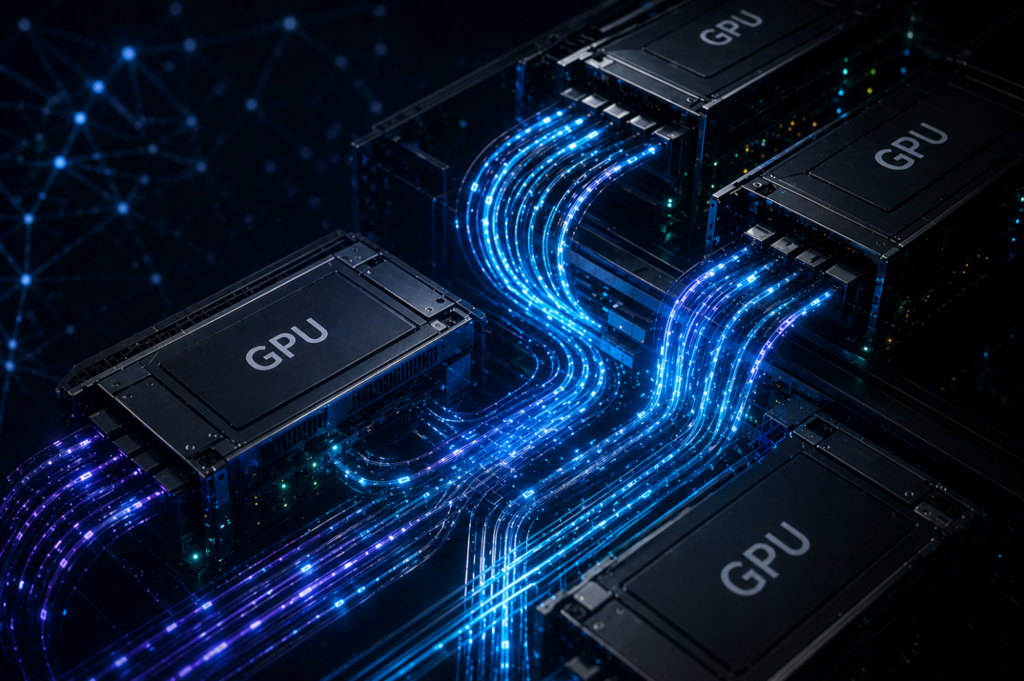
The math gets worse before it gets better. In large-scale clusters, moving data between GPUs can now consume more power than the computation itself. Every synchronization step between thousands of processors adds latency. Every added rack compounds the problem.
The result is a strange kind of diminishing return — you can keep adding compute, but performance stops following. The chips are ready. The data can’t get there fast enough.
The metric is no longer “how fast is the GPU?” but “how fast is the entire data center?” And the way to make the data center faster? Speed up the slowest piece — the interconnect.
Why the Current Playbook Runs Out
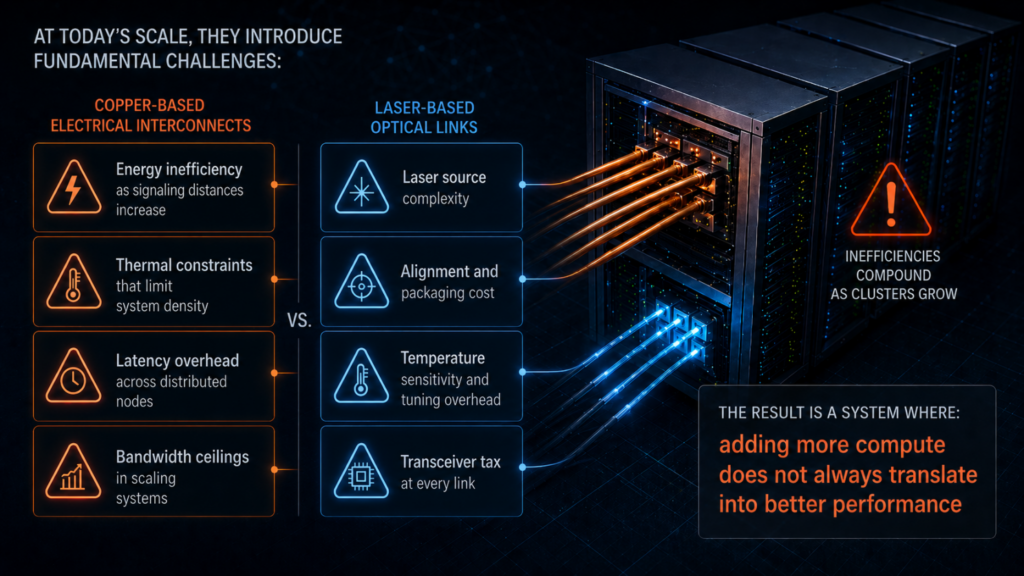
Today’s clusters lean on two technologies: copper electrical interconnects and conventional optical links — the laser-driven pluggable transceivers that have carried data center traffic for a generation. Both were engineered for an earlier era of computing, and at AI scale, their limits stop being theoretical.
Copper burns more energy the farther a signal travels. Heat accumulates, capping how denselysystems can be packed. Latency stacks up across distributed nodes. And bandwidth runs into hard physical ceilings that no amount of engineering cleverness fully escapes.
Lasers solve the distance problem but create new ones at AI density. They demand power-hungry light sources and precision alignment that drive up cost per lane. They’re temperature-sensitive components living in the hottest environments computing has ever built. And the transceivers around them add their own latency and energy tax on every bit — overhead that was tolerable for rack-to-rack traffic, but compounds brutally when it sits on every chip-to-chip link in a 100,000-GPU cluster.
These aren’t tuning problems. They’re architecture problems. And architecture problems require architectural answers.
Neural I/o™: Rebuilding the Connection Layer
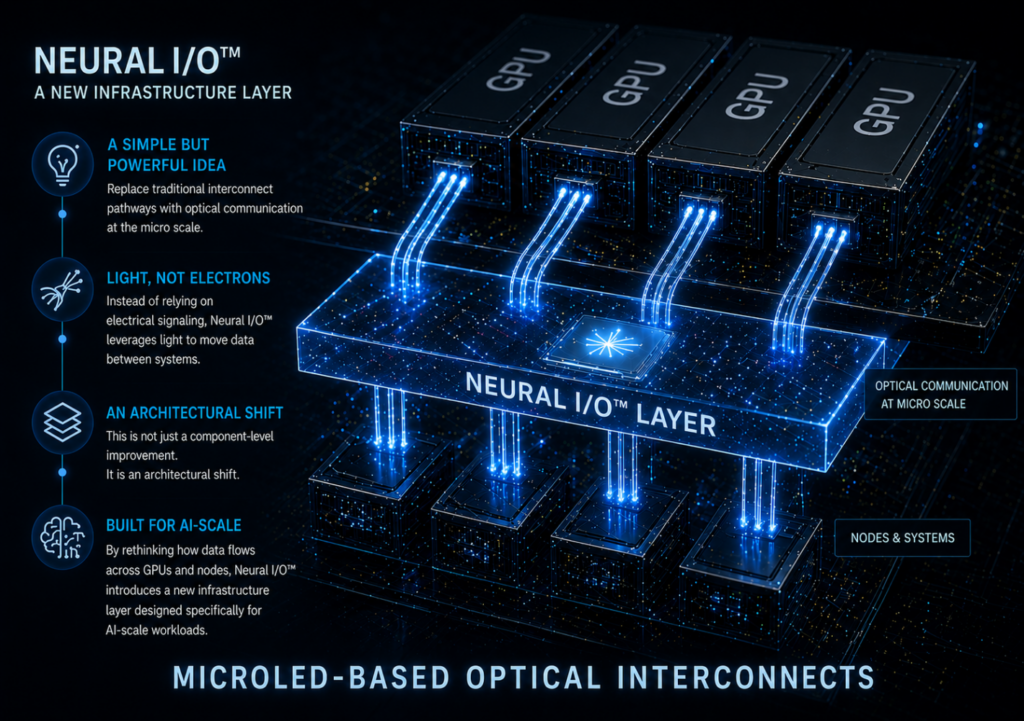
Neural I/o™, jointly being developed by Kopin and Fabric.AI, will start from a simple premise: stop pushing electrons through metal and start moving data with light — at the micro scale, woven directly into the fabric of the system.
And unlike conventional optical links, which rely on lasers, Neural I/o™ is expected to be built on MicroLED-based optical interconnects — an approach designed to bring the efficiency of light to chip-to-chip communication without the power, cost, and complexity overhead of laser-driven optics.
MicroLEDs also carry a scaling advantage lasers can’t match. A laser-based link adds bandwidth the hard way: every new lane means another laser, another alignment, another increment of cost and power — and eventually, another redesign. A MicroLED array scales the way a display does: add more pixels, get more parallel lanes. More bandwidth, same architecture. The scaling roadmap is built into the device itself, not bolted on around it.
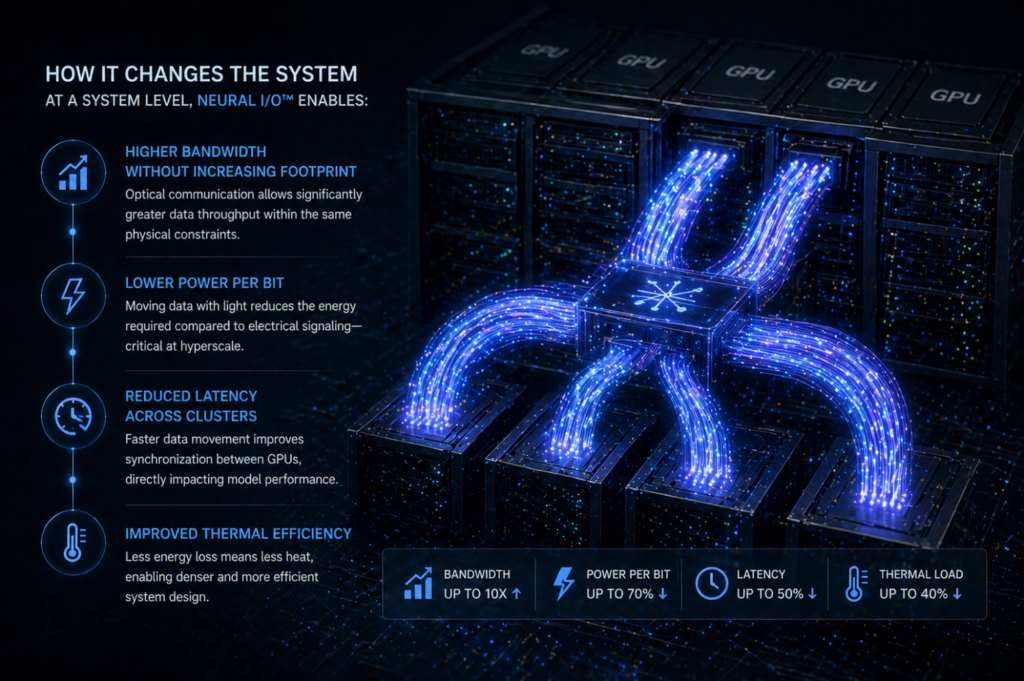
This isn’t a faster cable. It’s a new infrastructure layer, purpose-built for AI-scale workloads, that rethinks how data flows between GPUs and across nodes. At the system level, that shift will be designed to deliver:
More bandwidth in the same footprint. Optical communication is expected to move dramatically more data through the same physical constraints.
Less power per bit. Light is a fundamentally more efficient messenger than electrical signaling — a difference that becomes decisive at hyperscale. Lower latency across the cluster. Tighter GPU synchronization translates directly into faster training and inference.
Less heat, denser systems. Lower energy loss means designers can pack more capability into less space.
Why It Matters Beyond the Rack
Interconnect efficiency sounds like a plumbing detail. It isn’t. It shapes how AI systems are designed, scaled, powered, and deployed — which means it shapes the economics of the entire buildout:
Lower total cost of ownership for large-scale systems. Data centers that do more with less energy.
Scaling paths that don’t slam into thermal ceilings. Faster iteration on the models themselves.
As AI infrastructure expands globally, the cost of moving data stops being a footnote in the budget.
It becomes the budget.
Decades of Optics, Applied to a New Problem

Neural I/o™ isn’t a pivot for Kopin. It’s a continuation.
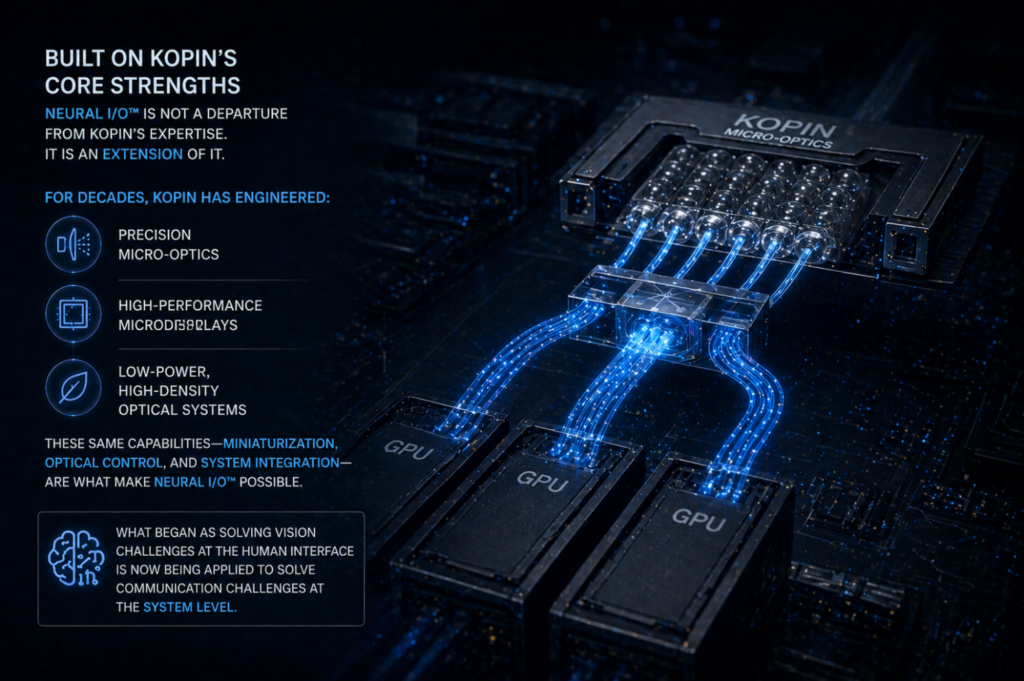
Kopin has spent decades engineering precision micro-optics, high-performance microdisplays, and low-power, high-density optical systems. A microdisplay is, at its core, millions of precisely controlled light emitters packed onto a chip — which is exactly the capability that turns pixels into data lanes. Miniaturization, optical control, system integration: the same disciplines, pointed at a new problem.
The company that solved vision challenges at the human interface is now applying that same discipline to communication challenges at the system level.
The Bigger Shift
Step back, and Neural I/o™ is expected to be part of a larger transition rippling through computing: compute is no longer the only constraint, optics are becoming foundational to system performance, and infrastructure is finally evolving to match AI’s scale.
We’re heading toward systems where light — not electricity — is the primary medium of communication. Where efficiency defines scalability. Where architecture matters as much as hardware.
The next era of AI won’t be defined by faster chips alone. It will be defined by how intelligently systems move information — a future where infrastructure evolves alongside intelligence, and performance is no longer limited by the distance between machines.
To learn more about Fabric.AI and its work advancing next-generation AI infrastructure, visit fabricai.com.